THE KUZ NETWORK — KUZAI.ORG
UNIFIED TECHNICAL WHITE PAPER
Project Manager & System Administrator
github.com/Kusanagi8200
admin@kuzai.org
Part A — KUZAI.ORG - TECHNICAL WHITE PAPER
PROJECT OVERVIEW — THE KUZ NETWORK & KUZAI.ORG
Kuzai.org is a core component of THE KUZ NETWORK, an open technical initiative dedicated to the exploration, structuring, and documentation of modern artificial intelligence systems and their real-world applications.
The project operates at the intersection of:
- AI tools indexing and evaluation
- Open-source software ecosystems
- Linux system administration
- Production-grade infrastructure engineering
Rather than acting as a commercial marketplace or a marketing-driven directory, Kuzai.org is designed as a neutral, technical, and reproducible reference platform. The infrastructure, automation pipelines, and governance model are considered first-class components of the project.
This white paper documents both the current operational state of Kuzai.org and its planned evolution toward an intelligent, automated, and collaborative AI indexing platform, fully integrated within The KUZ Network ecosystem.
INTRODUCTION
In the context of the explosion of accessible artificial intelligence solutions online, Kuzai.org positions itself as an open initiative aiming to structure, classify, and contextualize all AI tools available on the market. This whitepaper presents the current technical state of the platform and outlines its future development directions, both functional and infrastructural.
OBJECTIVE AND CURRENT ARCHITECTURE
Kuzai.org was designed to meet a fundamental need: providing a unique, organized, and neutral entry point for users facing the fragmentation of the AI ecosystem. Unlike commercial directories or overloaded marketplaces, Kuzai.org adopts a transparent and categorized technical indexing approach.
2.1 FEATURES IN PRODUCTION
- Search engine filtered by usage (image generation, text summarization, OCR, NLP, etc.)
- Detailed AI tool sheets (publisher, official site, model used, license, cost)
- Navigation by technical tags (open source, available API, GPT model, etc.)
- Categorization by type (visual, audio, video, development, assistant, etc.)
- Lightweight web interface compatible with mobile devices
- Basic web security: HTTPS, secure HTTP headers, Apache with ModSecurity enabled
2.2 TECHNICAL STACK
- Backend: PHP 8.2 (architecture currently migrating to Laravel)
- Frontend: HTML5, CSS3, Bootstrap (progressive move to Tailwind)
- Database: MariaDB, schema optimized for taxonomy-based search
- Infrastructure: Debian Linux VPS, secure LAMP stack (SSL, WAF, fail2ban)
- System administration: manual deployment via shell / rsync, no automated CI/CD yet
IDENTIFIED LIMITATIONS AND CONSTRAINTS
- Lack of intelligent search engine (classic full-text search, no embedded LLM)
- No user management or personalization features
- Semi-manual indexing process requiring human validation
- No public API for third-party integrations or exports
- No dedicated web administration interface
ROADMAP AND PLANNED TECHNICAL EVOLUTIONS
4.1 PLANNED FEATURES (Q4 2024 – Q1 2025)
- Optional user accounts (favorites, voting, comments)
- Multi-criteria community ratings (UX, performance, ethics, cost)
- AI recommendation engine (LLM-guided search)
- Intelligent navigation assistant (embedded chatbot)
- Interactive comparison tables
- Export of search results (CSV, PDF, JSON)
4.2 INFRASTRUCTURES AND TOOLS TO INTEGRATE
- Full migration to Laravel with strict MVC separation
- Lightweight CI/CD (GitHub Actions or GitLab CI)
- Docker-based deployment and scalability
- Integration of Meilisearch or ElasticSearch
- Python pipelines for automated indexing and AI enrichment
OPENNESS AND COMMUNITY COLLABORATION
True to its philosophy, Kuzai.org is an open, interoperable, and community-driven project. Planned open components include:
- Standardized
.kuzai.jsonindex format - AI metadata parser
- Ethical scoring engine (beta planned early 2025)
A public Git repository will host contributions, audits, and community-driven tool definitions.
CONCLUSION
Kuzai.org is not merely a list of AI links. It is a structured attempt to map the rapidly evolving AI ecosystem with technical rigor, transparency, and long-term sustainability.
The project is currently at a strategic transition point, evolving from a stable but artisanal foundation toward an intelligent, scalable, and collaborative platform. Contributions, partnerships, and technical feedback are welcome.
Part B — INFRASTRUCTURE DEEP DIVE
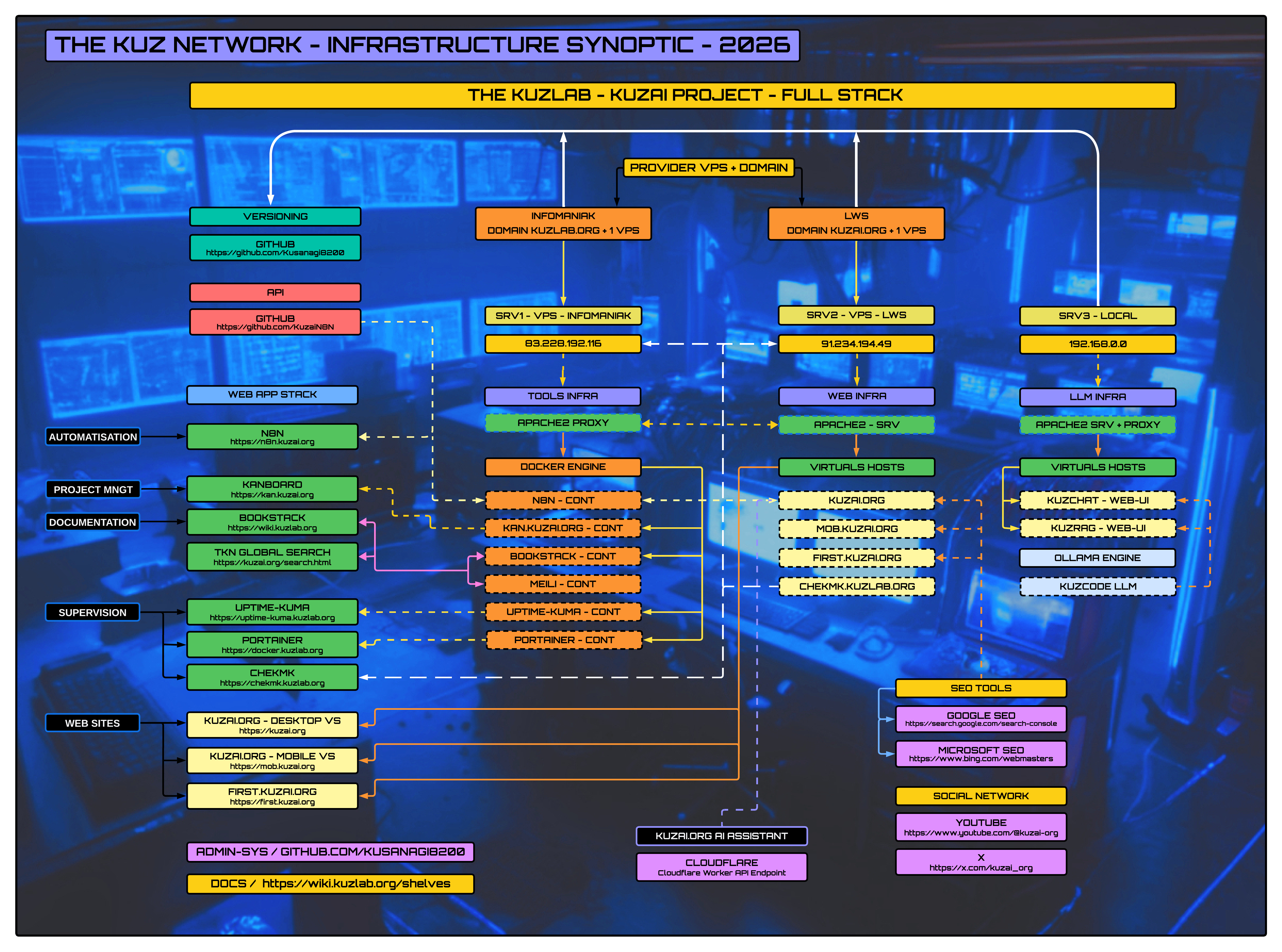
1. Infrastructure Synoptic (SRV1 / SRV2 / SRV3)
THE KUZ NETWORK relies on a deliberately segmented infrastructure model. Each server fulfills a clearly defined role, reducing coupling, improving security, and enabling independent evolution of services.
2. SRV1 — Infomaniak VPS (Back-office & Automation)
Primary role --> Internal Services, Automation, Supervision, Documentation.
2.1 Hosted domains and services
kuzlab.orgwiki.kuzlab.org- BookStack (technical documentation)
- n8n (automation engine)
- Uptime-Kuma (availability monitoring)
- CheckMK (system metrics)
- Postfix (notification relay)
2.2 System stack
- Debian Linux
- Apache (restricted exposure)
- MariaDB
- PHP 8.2
- Docker Engine
2.3 Automation layer
- n8n workflows for AI news aggregation
- GitHub monitoring
- Scheduled indexing jobs
- Git-based persistence for traceability
2.4 Security posture
- SSH key-only access
- fail2ban
- Strict firewall rules
- Service isolation via Docker
3. SRV2 — LWS VPS (Public Front & SEO)
Primary role --> Public-facing services and SEO-optimized delivery.
3.1 Hosted domains
kuzai.orgmob.kuzai.orgfirst.kuzai.org
3.2 Web stack
- Debian Linux
- Apache2 with VirtualHosts
- HTTPS via Certbot
- Security headers (HSTS, CSP, X-Frame, etc.)
- ModSecurity (WAF)
3.3 Application layer
- PHP 8.2 (Laravel migration)
- HTML / CSS / Bootstrap → Tailwind
- MariaDB (replicated or synced schema)
- Meilisearch (Docker)
3.4 Search architecture
- Legacy SQL search (classic approach)
- Meilisearch for fast full-text search, filtering and ranking
- Semantic extension planned (vectorization / RAG)
4. SRV3 — Local AI Server (LLM & RAG Lab)
Primary role --> AI computation, experimentation, and inference.
4.1 AI stack
- Debian Linux
- NVIDIA GPU support (CUDA)
- Ollama (local LLM runtime)
- Custom LLM containers
4.2 Use cases
- KUZAI Assistant (LLM-powered navigation)
- Document analysis and enrichment
- Pre-RAG experimentation
- Prompt and model benchmarking
4.3 Isolation principles
- No direct public exposure
- API access restricted to SRV1 / SRV2
- Model execution fully local
5. Data Flows and Interconnections
5.1 Indexing pipeline
- Data collection (manual + automated)
- Normalization (
.kuzai.json) - Storage in MariaDB
- Indexing into Meilisearch
- Exposure via web UI and assistant
5.2 AI enrichment pipeline
- Python scripts for metadata enrichment
- Local LLM summarization
- Tag suggestion and classification
6. Containerization Strategy
- Docker Engine on all servers
- One service = one container
- Explicit network separation
- Volume-based persistence
- Reproducible deployment
7. Observability & Operations
- Uptime-Kuma for service availability
- CheckMK for host-level metrics
- Centralized logs
- Controlled Git workflows (manual CI)
8. Design Philosophy
- Open-source first
- Minimal abstraction
- Reproducibility over automation hype
- Human-readable infrastructure
9. Conclusion
This infrastructure reflects a pragmatic approach to AI systems engineering. By separating concerns between public delivery, automation, and AI computation, THE KUZ NETWORK provides a stable foundation for experimentation, scaling, and long-term maintainability.